Face proportions, explained.
Learn what each number in your report measures and how to read it. Explore four proportions, one eye-corner angle and one mirror-difference measure, all calculated from visible landmarks in a photo.
Measurements run in your browser. No account or payment details are needed for the free result.
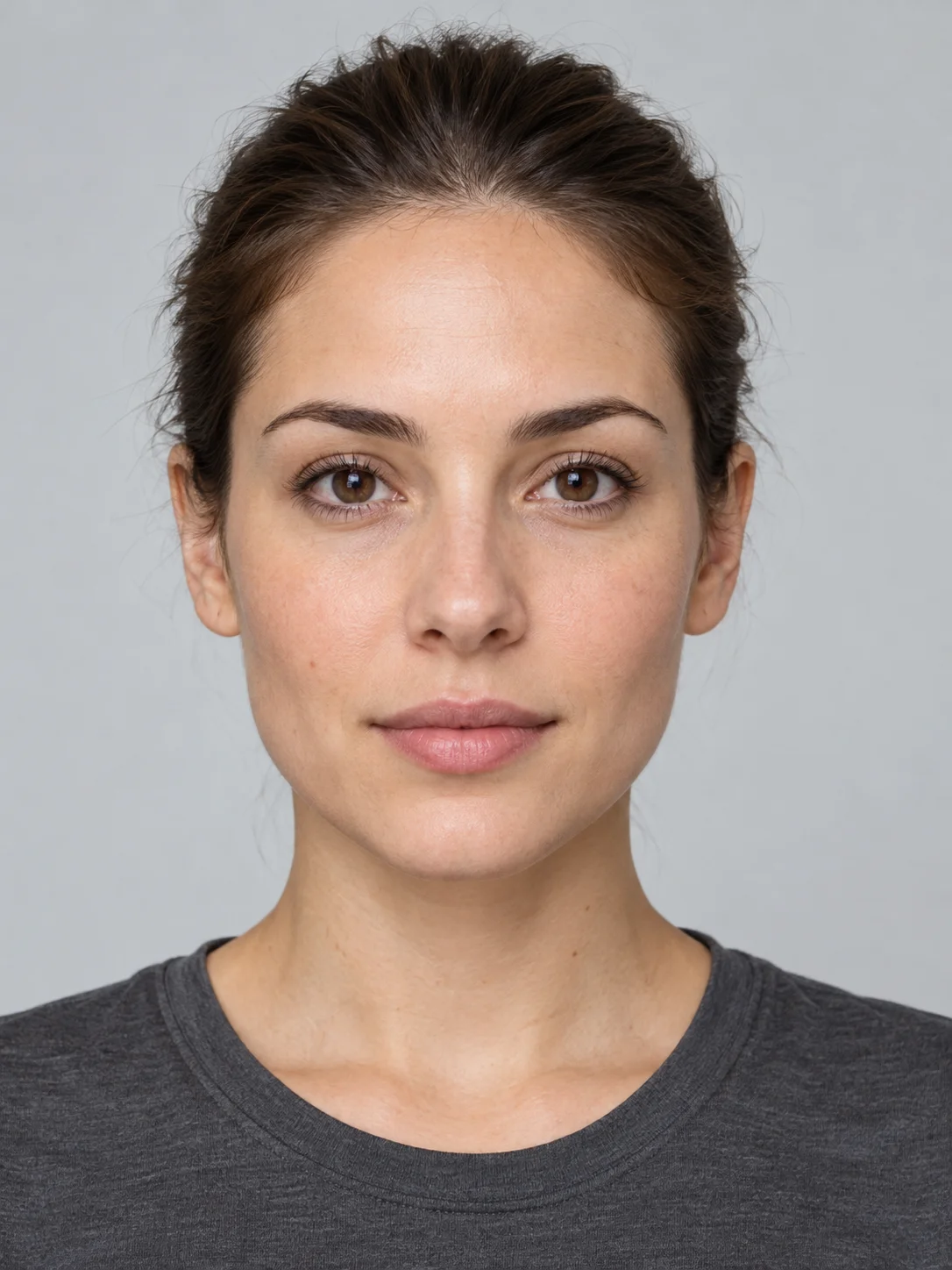
Upper forehead landmark to chin, divided by cheek width. The upper landmark is not your hairline.
Values come from this example portrait, not your photo. Solid lines mark measurement segments; dashed lines mark references. The mirror view highlights the eight point pairs being compared, not the size of their differences.
Start with the measurement, then the meaning
The browser locates facial landmarks and converts their positions using the image width and height. Distances are measured between those points in the image. The forehead-to-chin axis provides a reference for correcting sideways head tilt in the eye-angle and mirror-difference calculations. This does not remove perspective distortion or turn a front photo into a 3D measurement.
Face length / width
Example value1.21: 1
Upper forehead landmark to chin, divided by cheek width. The upper landmark is not your hairline.
CalculationUpper-forehead-to-chin distance ÷ cheek span
The result is shown relative to 1 unit of cheek width. A larger value means the measured length is greater relative to that span in this image. The top endpoint is a visible forehead landmark, so a hairline-to-chin measurement uses a different definition. Read this value alongside forehead and jaw widths rather than treating it as a face-shape cutoff.
Forehead width
Example value86.7%
Width between two upper forehead landmarks, as a percentage of cheek width.
CalculationUpper-forehead landmark span ÷ cheek span × 100
The cheek span is the 100% reference. A value below 100% means these forehead landmarks are closer together than the cheek landmarks in this image. It does not measure the full hairline. Since forehead and lower-jaw readings use the same denominator, comparing them can help describe how the measured outline changes from top to bottom.
Lower-jaw width
Example value78.2%
Width between two lower-jaw landmarks, as a percentage of cheek width.
CalculationLower-jaw landmark span ÷ cheek span × 100
This describes the lower-jaw span relative to the cheeks. A smaller value means the selected jaw landmarks are closer together relative to cheek width. It does not measure the angle of the jaw, chin projection or side profile. Combine it with the forehead and length readings when interpreting the outline.
Eye spacing
Example value37.5%
Inner eye-corner gap, as a percentage of the span between the outer eye corners.
CalculationInner eye-corner gap ÷ outer eye-corner span × 100
The denominator runs from the outside corner of one eye to the outside corner of the other. It is not the width of one eye and does not use pupil centers. The result describes the inner gap within that total span, so it cannot be used as a prescription pupillary distance or compared directly with a rule based on individual eye width.
Eye-corner tilt
Example value6.9°
Average outer-corner elevation after correcting sideways head tilt. Positive values mean the outer corners sit higher.
Calculation(Left outer-corner elevation angle + right outer-corner elevation angle) ÷ 2, after correcting sideways head tilt
Each angle describes the eye-corner line relative to the horizontal direction perpendicular to the forehead-to-chin axis. Positive values mean the outer corners sit higher on average in this projection; negative values mean lower. The reported mean can hide a difference between the two eyes. It is an angle in degrees, not a percentage or an attractiveness rating.
Mirror difference
Example value0.8%
Average distance between eight mirrored landmark pairs, as a percentage of cheek width. Smaller values mean closer alignment in this photo.
Calculation(Sum of mirrored offsets for 8 landmark pairs ÷ 8) ÷ cheek span × 100
For each pair, one point is reflected across the forehead-to-chin axis and its 2D distance from the partner is measured. The eight pairs cover the cheeks, forehead, jaw, inner and outer eye corners, brows, lips and nose. A smaller result means less average offset in this image. It is not a percentage of the face that is asymmetric, and subtracting it from 100 does not produce a symmetry score.
Read the numbers together
Face length, forehead width and lower-jaw width share the cheek span as a reference, so they help describe the overall outline together. Eye spacing uses the span between the outer eye corners instead. Mirror difference describes an offset. These percentages have different meanings and should not be ranked against one another. Only the three outline proportions contribute to the six-shape comparison; the two closest matches are references, not confidence percentages.
How we estimate face shapeWhat a photo can tell you
These values describe the visible projection in one photo. Camera angle, distance, expression, lighting and landmark placement can change them. To compare photos, use similar conditions and check the measurement definitions first. The results do not establish physical sizes, population percentiles, health findings or attractiveness. No ideal proportion or score is assigned.
Questions about face proportions
Can I convert these face proportions to millimeters?
Not from this result alone. Ratios compare distances within the image, and an uncalibrated photo does not provide a reliable physical scale. Changing image size can preserve a ratio without revealing the real distance between the points.
What are ideal face proportions?
This tool does not define an ideal face, a golden-ratio target or a demographic average. Its values describe the landmarks in one image. Use the definitions to understand the result and explore style preferences, rather than treating a number as something to correct.
Is the eye-spacing measurement my pupillary distance?
No. It compares eye corners and is displayed as a proportion. Pupillary distance uses pupil centers and a physical unit. Do not use this value to order prescription glasses; obtain the appropriate fitting measurements separately.
Why do my measurements change between photos?
A change in camera angle, distance, expression or lighting can move the detected landmarks and alter the projected proportions. Correcting sideways tilt does not correct every camera effect. Compare clear, front-facing photos taken under similar conditions before interpreting a difference.
Does mirror difference tell me how symmetric my face is?
It describes the average alignment of eight selected landmark pairs after reflection across the photo’s estimated face axis. It does not assess the entire face, give a population ranking or diagnose a condition. A small value means those points align more closely in that particular image.
Are all six measurements free?
Yes. The six measurements, two face-shape references and measurements PDF are free, without an account or payment details. A separate one-time purchase adds AI observations and personal hair and eyewear ideas. With consent, checkout uploads the prepared photo and landmarks for temporary encrypted storage; AI generation starts after payment is verified.